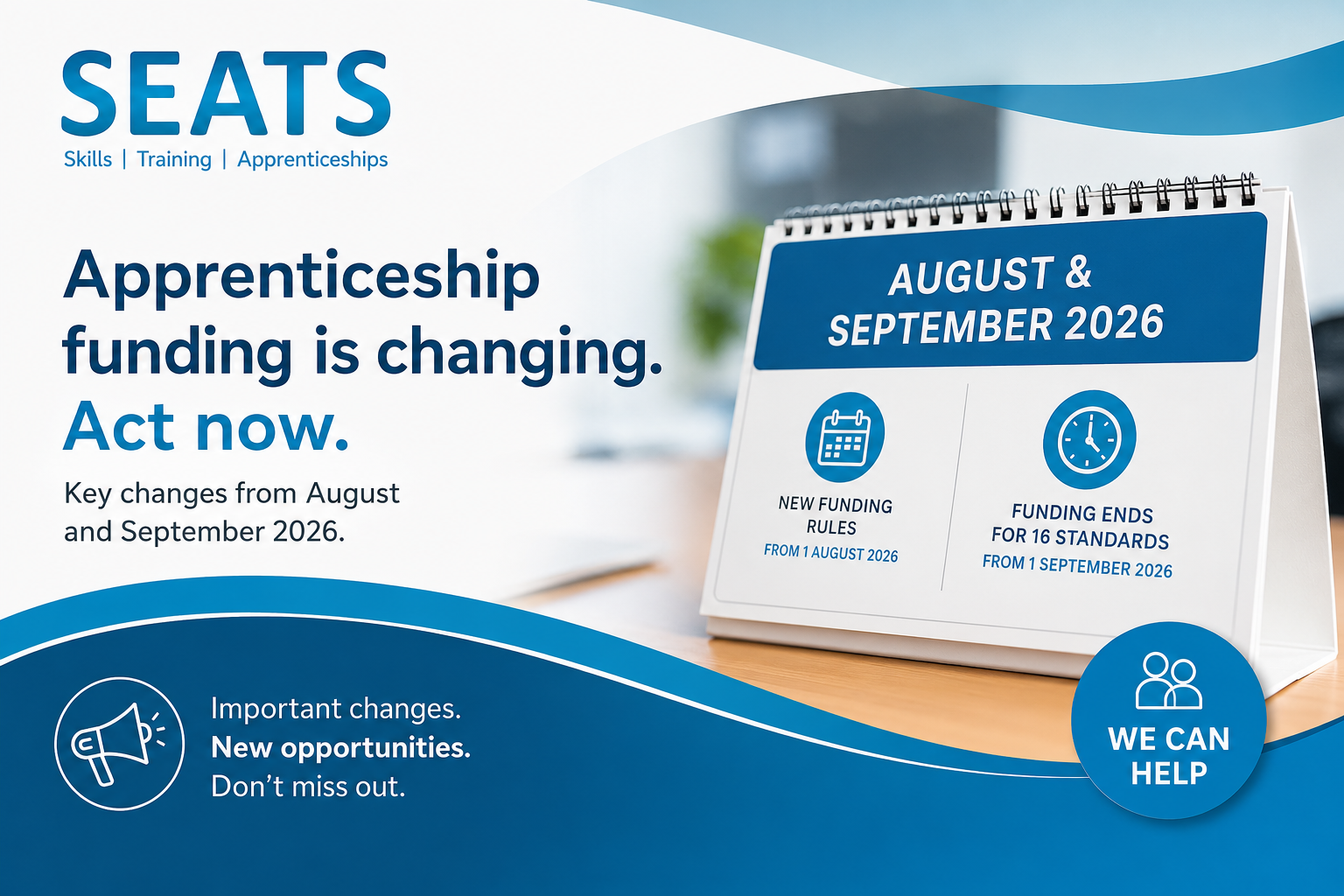
Important changes to apprenticeship funding come into effect from 1 August 2026, with further changes following on 1 September 2026.
Some of the changes create valuable new opportunities, particularly for smaller employers looking to recruit younger apprentices. Others mean businesses need to look for alternatives if they were planning to use certain management, leadership, coaching or professional apprenticeships.
What changes on 1 August 2026?
Apprentices aged 16 to 24 will be fully funded for non-levy employers
From 1 August 2026, employers that do not pay the apprenticeship levy will have the full training and assessment costs covered for apprentices aged 16 to 24, up to the apprenticeship’s maximum funding band.
This means there will be no 5% employer contribution towards the eligible training costs of these younger apprentices.
For apprentices aged 25 or over, non-levy employers will continue to pay 5% of the eligible training and assessment costs, with the government paying the remaining 95%. SEATS can assist with the 5% via levy share schemes – speak to our team.
This is a significant opportunity for small and medium-sized employers to bring new talent into their business without having to meet the cost of the apprenticeship training.
Levy-paying employers will lose the 10% government top-up
At present, money entering an employer’s apprenticeship service account receives an additional 10% government top-up.
For new funds entering levy accounts from 1 August 2026, this top-up will no longer be added. Levy-paying employers should therefore review their expected levy income, planned apprenticeships and available account balance carefully.
The cost of running out of levy funds will increase
Where a levy-paying employer does not have enough money in its apprenticeship service account to cover a new apprenticeship starting from 1 August 2026, the government will contribute 75% of the eligible training and assessment costs.
The employer will be responsible for the remaining 25%.
This is a substantial increase from the previous 5% employer contribution and makes forward planning much more important for levy-paying businesses.
The same 75% government contribution applies to apprenticeship units where a levy payer has insufficient funds, leaving the employer responsible for the outstanding 25%.
Employers will need to approve apprenticeship records
Training providers will add the learner and training details to the funding system. Employers must then check and approve the information through their apprenticeship service account before funding can be accessed.
Employers should make sure the correct people have access to their account and that apprenticeship approvals are not left sitting unanswered.
PAYE information must be kept up to date
The PAYE scheme used to pay the apprentice must be declared in the employer’s apprenticeship service account. Employers may be asked to provide evidence confirming which PAYE scheme the apprentice is paid through.
New rules reinforce the need for a genuine job role
The apprentice’s job must have a clear and substantial connection to the apprenticeship. The programme must help the individual become fully competent in that occupation.
An apprenticeship should not be selected simply because funding is available; it must genuinely match the employee’s role and development needs.
Employers will confirm that the training has been delivered
At the end of the programme, the employer, apprentice and training provider must agree that the content set out in the training plan has been delivered.
This can be recorded in the training plan or through the provider’s final review process.
What changes on 1 September 2026?
Government funding will be withdrawn from 16 apprenticeship standards for new starters from 1 September 2026.
Existing apprentices who started before this date can continue to receive funding through to completion.
The affected apprenticeships are:
- Team Leader
- Operations Manager
- Chartered Manager Degree Apprenticeship
- Coaching Professional
- Improvement Practitioner
- Improvement Leader
- Learning and Skills Assessor
- Learning and Skills Mentor
- Facilities Management Supervisor
- Custody and Detention Professional
- Security First Line Manager
- Public Sector Compliance Investigator and Officer
- Cleaning Hygiene Operative
- Outdoor Learning Specialist
- Professional Security Operative
- Lead Practitioner in Adult Care
Skills England has confirmed on the individual apprenticeship records that funding will end for new starts from 1 September 2026. Current learners who started before the deadline can continue.
The withdrawal is particularly significant for employers using apprenticeships to develop supervisors, managers and workplace coaches. Team Leader, Operations Manager, Coaching Professional and Chartered Manager Degree Apprenticeships are all included. SEATS are fully prepared for these changes with the development of The Practical Leadership Series.
What should employers do now?
Employers should not wait until the end of August to begin discussions.
Before enrolling anyone, businesses should:
- Review their workforce and succession plans.
- Identify employees who may benefit from an affected apprenticeship.
- Check that the apprenticeship genuinely matches the employee’s role.
- Levy payers should review their account balance and future levy income.
- Non-levy employers should consider whether recruiting an apprentice aged 16 to 24 could support an existing skills shortage.
A further opportunity from October 2026
From 1 October 2026, non-levy employers will be able to receive a £2,000 hiring payment when recruiting an eligible apprentice aged 16 to 24.
The apprentice must start their apprenticeship from 1 October 2026 and must have joined the employer within the previous three months. The payment will be made in two instalments, with the first becoming available after the apprentice has completed the first 90 days of the apprenticeship.
SEATS can help
These changes create both opportunities and risks.
SEATS can help employers:
- identify genuine business and workforce skills needs;
- understand which apprenticeships remain funded;
- compare suitable training providers;
- review levy balances and funding options;
- explore levy transfers for smaller employers;
- support enrolment and account administration;
- brief line managers;
- and provide continued support throughout the apprenticeship.
The funding landscape is changing quickly, but employers do not have to navigate it alone.
Speak with the SEATS team now to understand what the changes mean for your organisation.